Scripted NPCs are Dead: NVIDIA ACE Leads the AI Revolution
Are you fed up with boring NPCs repeating the same lines and responding to the same scripted scenarios? The artificial intelligence age rewrites the rules, and
NVIDIA ACE takes the lead. Scripted NPCs are dead, replaced by intelligent and dynamic gaming characters that learn, adapt, and respond in ways you never dreamed.
Non-playable characters (NPCs) usually follow strict rules. These rules make them seem intelligent. They stick to a controlled story and have scripted interactions with the player. But with the rise of innovative language models, AI is ready to be overhauled intelligently.
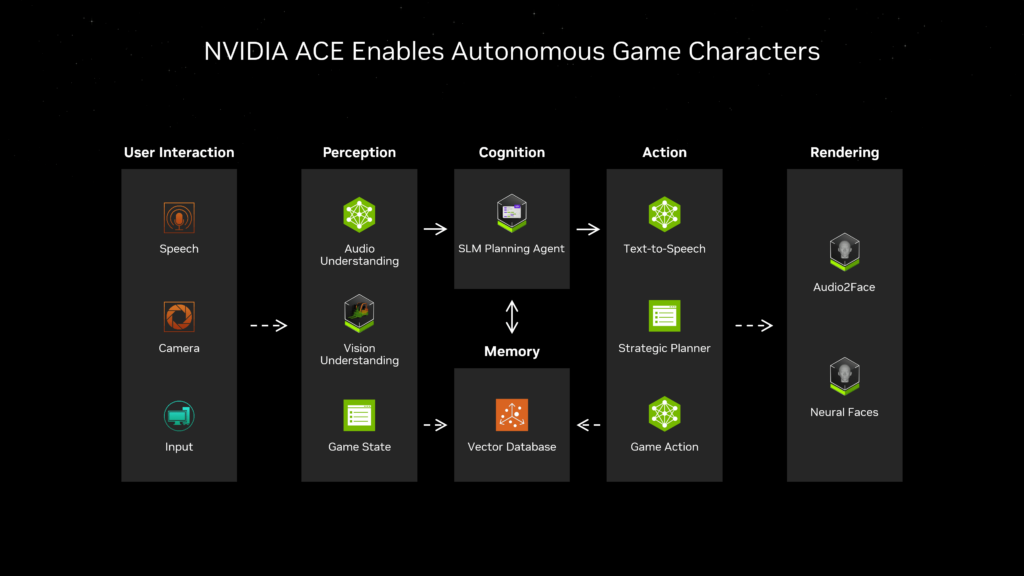
Launched in 2023, NVIDIA ACE incorporates RTX-accelerated digital human technologies that bring game characters to life using generative AI. Now, NVIDIA ACE expands from conversational NPCs to providing game characters with the ability to perceive, plan, and act like human players.
The Art and Science of Human Decision Making
By harnessing generative AI, ACE unleashes living, dynamic game worlds with companions that understand and support player goals and enemies that can adapt dynamically to player tactics.
These autonomous caretakers are powered by the new ACE small language models (SLMs), which offer the real-time situational awareness necessary for realistic decision-making, along with multi-modal SLMs providing vision and audio through which AI characters can hear audio cues and understand their environment.
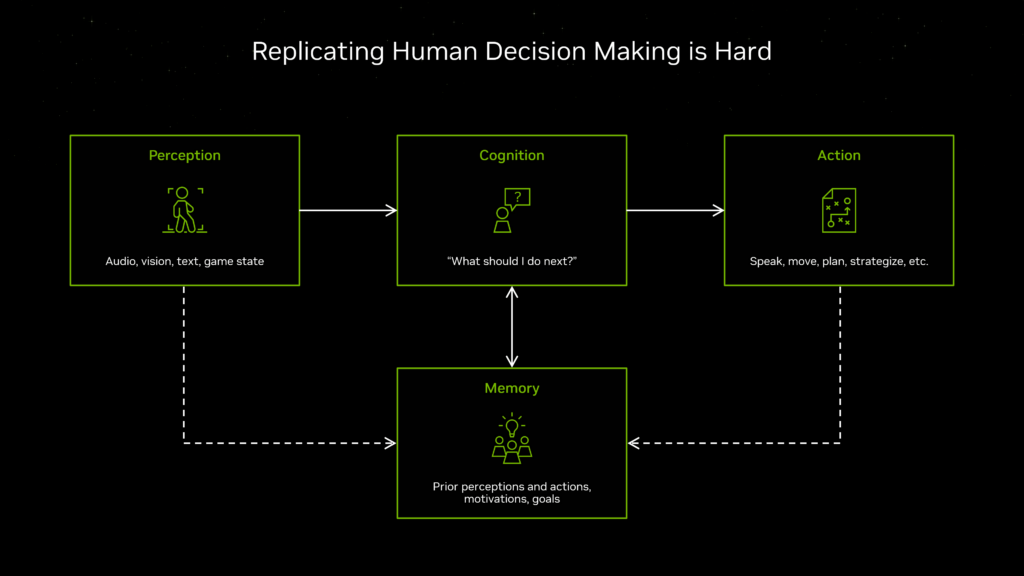
Let’s begin with a simple model of how humans make decisions and the basic instinct behind any action.
In its essence, the decision-making process is an internal dialogue wherein we wrestle with a deep-rooted question that echoes through our soul: ‘What do I do next?’
To arrive at a thoughtful answer to that question, we must gather several crucial insights:
Information from World around Us
Our decisions are primarily influenced by the context within which we operate. This context encompasses present conditions, trends, and circumstances which jointly shape the overall environmental perception. By being aware of ourselves and the world around us, we would understand the options available to us and the possible impacts such choices would have. Such awareness can help assess the alternatives from an informed choice perspective that aligns with reality.
Our Motivations and Desires
We need to find out what drives us because that influences the nodes of our choices and decision-making. Our motives – not necessarily steeped in personal values, aspirations, and emotional needs – govern our decisions. These realizations help us become discreet about what we sincerely desire and why we do so, thus enriching our choices with that personal touch and enhancing fulfilment and satisfaction.
Memories of Prior Events or Experiences
Our past experiences are excellent teachers of what has worked for us and what has not. When bringing earlier decisions and their results to mind, we can recognize patterns and lessons that inform our current choices. This reflection allows us not only to avoid mistakes but also to replicate successes and, consequently, helps us make better future decisions.
To illustrate, suppose you are on a football field. You get the ball passed from your teammate. When you touch the ball, all your senses activate, and you assess the situation: shoot the ball at the goal or pass it to the other player.
As you weigh your options, you recall your recent training sessions where you practiced shooting from this distance and remember the last match where you missed a similar opportunity. Your desire to score and contribute to the team’s success fuels your decision-making process. This blend of past experiences and current motivations is the essence of cognition.
In the end, you make the shot. You channel all your skills and instincts into that one action. An action that reflects the culmination of your cognitive process and the motivations driving your choices.
How NVIDIA’s AI is Shaping the Future of Intelligent Systems
A developer cannot code to mimic these human traits with a traditional rule-based AI system because the number of possible scenarios is virtually limitless. However, generative AI and large language models, trained on vast amounts of text that capture human behavior and reactions, allow us to start emulating decision-making processes that resemble real people. This breakthrough could be the precursor to more realistic gaming and real-life interactions that make characters seem more authentic and lifelike in their response.
Understanding Perception – The Fundamental Actions That Shape Our Reality
It’s essential to maintain a flow of perception data from the environment that an autonomous game character could use for decision-making, such as SLMs by NVIDIA, to make appropriate decisions. It would allow a character to interpret and act upon sensory inputs from the environment. To do this, NVIDIA uses multiple models and techniques to capture, process, and analyze sensory data – for example, visual inputs from the game world, auditory cues from surrounding actions, and even haptic feedback from player interactions. NVIDIA helps the NPC develop an even more elaborate understanding of its surroundings by fusing such diverse data sources, thus enhancing its ability to navigate challenges and make informed choices in real-time.
Several models and techniques are used to capture this sensory data:
Audio
- NemoAudio-4B-Instruct: NemoAudio-4B-Instruct is an advanced model developed by NVIDIA that focuses on understanding and describing soundscapes in gaming environments. It enhances the capabilities of AI characters by allowing them to interpret audio cues, thereby making interactions in games more immersive and responsive.
- Parakeet-CTC-XXL-1.1B: It is an advanced AI model that can be used for automatic speech recognition in multiple languages. Its record-breaking accuracy converts spoken language into text, making communication more accessible and efficient. The model improves the transcription quality and supports a wide range of languages, making it possible for global users to interact seamlessly. Through advanced deep learning techniques, Parakeet-CTC-XXL enables applications across customer service to create content and bridges the language barrier gap to facilitate inclusive communication.

Vision
- NemoVision-4B-128k-Instruct: NemoVision-4B-128k-Instruct is a multimodal AI model for roleplaying, retrieval-augmented generation, and function calling with improved vision understanding and reasoning. It has applications in domains such as gaming, allowing lifelike digital interactions and immersive storytelling experiences. With the help of distillation and quantization techniques, this model is efficient and delivers high-quality outputs, enabling developers to utilize the power of NVIDIA’s NeMo framework on various devices, making it available for large-scale and edge-computing applications.
Game State
The game is one of the richest sources of information in its virtual universe. Through transcribing the game state into text, NVIDIA ACE empowers SLMs to analyze and reason about the intricate dynamics of the game world. This textual representation allows SLMs to interpret events, understand player actions, and make informed decisions to increase autonomous game characters’ intelligence and responsiveness. Using native in-game data, NVIDIA ACE makes a game more engaging and interactive; AI can now evolve and adapt in real time, making every player’s gameplay experience richer.
Cognition: The Driving Force
Micro decisions, or “sub-movements,” are crucial in e-sports. They allow the player to implement complex strategies and respond quickly to in-game dynamics. Gamers on average make 8-13 sub-movements per second, which underlines the very high cognitive and motor skills required for competitive play.
These decisions range from simple actions, such as adjusting aim or timing skill usage, to more intricate strategic evaluations that can shift the course of a match. Advanced technologies, such as those developed by Nvidia, enable further optimization in cognitive processing that allows players to maintain a competitive edge in the fast-paced world of e-sports.
The ACE SLMs for cognition by NVIDIA are designed to improve the performance of AI-driven applications, especially in gaming and digital human interactions. These models are optimized for low latency and high throughput, allowing real-time processing and responsiveness essential for an immersive experience.
These ACE SLMs for cognition at NVIDIA have been built to compete with frequent requests of cognitive tasks so that AI applications can work efficiently with strict latency and throughput requirements. High-performance and real-time interactive environments, that is, playing games or virtual assistants, are areas where these models perform well.
ACE SLMs for cognition include:
- Mistral-Nemo-Minitron-8B-128k-Instruct: Mistral-Nemo-Minitron-8B-128k-Instruct is an advanced AI model for diverse text-generation tasks, such as roleplaying and retrieval-augmented generation. It comes with a significant context window of up to 128k tokens, ensuring that responses are both highly accurate and efficient, while its architecture is robust, with 8.41 billion parameters. The model is exceptional in instruction-following capabilities, which makes it a powerful tool for applications that require nuanced understanding and generation of complex text. Such a novel design establishes Mistral-Nemo-Minitron-8B-128k-Instruct as an innovation standard for AI performance. It ensures frictionless interactions within all domains.
- Mistral-Nemo-Minitron-4B-128k-Instruct: Mistral-Nemo-Minitron-4B-128k-Instruct is a lightweight but robust AI model optimized for several text-generation tasks, including roleplaying and function calling. With up to 128k tokens and 4 billion parameters in the context window, this model can efficiently provide precise responses with an interactive user interface. It’s made to excel at instruction-following tasks, which makes it highly suitable for applications requiring quick, relevant interactions. Its innovative architecture ensures that Mistral-Nemo-Minitron-4B-128k-Instruct stands out in the landscape of small language models, providing a robust solution for real-time AI applications across multiple industries.
- Mistral-Nemo-Minitron-2B-128k-Instruct: Mistral-Nemo-Minitron-2B-128k-Instruct is a leading-edge AI model for text generation on the most diverse tasks ranging from role-playing to function calls. It excels at offering exact, contextually relevant responses due to its 128k token context window and 2 billion parameters. This model is engineered with instruction-following capabilities, and it’s excellent for applications requiring fast and accurate interaction. Its advanced architecture puts Mistral-Nemo-Minitron-2B-128k-Instruct in a prime position as one of the best compact language models, fulfilling all kinds of real-time AI requirements in many sectors. This model is so tiny that it can fit within 1.5GB of VRAM.
Action: Models Designed to Navigate and Influence the World
Action can take many forms, from spoken dialogue to in-game moves and long-term strategy planning. Nvidia ACE enables developers to leverage a combination of models and strategies to execute effective action. Action selection allows SLMs to to choose the best move from a finite set of choices, while advanced text-to-speech technologies, such as ElevenLabs or Cartesia, can turn text responses into engaging audio outputs.
Agents can leverage larger models using cloud LLM APIs or Chain-of-Thought prompts to derive high-level strategies from extensive data in strategic planning. Moreover, reflection on past actions helps characters evaluate their choices, making them self-correcting and improving future decisions. This is a holistic approach that ensures that AI-driven interactions are not only responsive but also adaptive and intelligent.
Memory: Models Engineered to Retain and Recall the World
Memory is crucial for autonomous game characters, enabling them to recall prior perceptions, actions, and cognitive processes. This helps ensure their ability to respond within the immediate moment but also permits monitoring of extended time frames regarding goals and motivations that may not be pertinent in the short-term moment. By using advanced memory models, Nvidia ACE endows these characters with the ability to create more prosperous and more immersive experiences because they can draw on their history to inform decisions and interactions, which, therefore, leads to more engaging and lifelike gameplay.
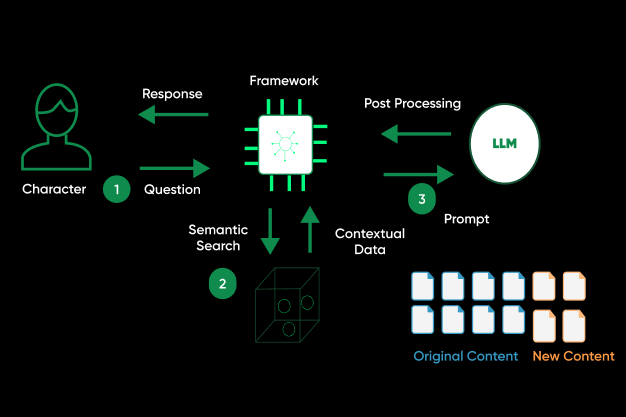
Using a technique called
Retrieval Augmented Generation (RAG), developers can use similarity searches to “remember” relevant information to the current prompt:
- E5-Large-Unsupervised: The E5-Large-Unsupervised model is a text embedding model explicitly designed to generate high-quality embeddings from input text without fine-tuning it in a supervised manner. It includes 24 layers and an embedding size of 1024 and is highly suitable for various tasks in natural language processing, including zero-shot applications and fine-tuning scenarios. This way, E5-Large-Unsupervised allows for a robust architecture that enables more efficient and flexible text representation, opening doors to better semantic search performance and other NLP applications. Among the most attractive features of this model is its robust ability to work with diverse data inputs, making it quite useful for developers and researchers.
Conclusion
The journey into this new gaming frontier is just beginning, and the innovation potential is limitless. As a forward-thinking
digital transformation company, we’re closely watching how this space evolves and reshapes interactive experiences. In our upcoming blog, we will spotlight the exciting partnerships NVIDIA ACE has formed with various games, showcasing how NPCs are being upgraded-from a trusty teammate in PUBG to the formidable final boss in MIR5.
There’s so much more to explore, and the future of gaming promises to be as thrilling as it is immersive. Stay tuned for more updates and prepare to witness the next chapter in the evolution of intelligent gaming!


Leave a Reply